緑濃く燃ゆる大地。
龍の気配息づくこの国に生きる私たちの心を、豊かに彩ってくれる日本文化の数々。
私たちはもっともっと我らが文化を誇り、愉しむべきでしょう。
あなたはどんな日本文化がお好きですか?
今回のテーマは「盆栽」です。
さぁ、ひとまず日常の煩わしさは忘れて、共に日本の美と祈りの世界に没入しましょう🌸
第七話 盆栽
圧倒的なバランスの美
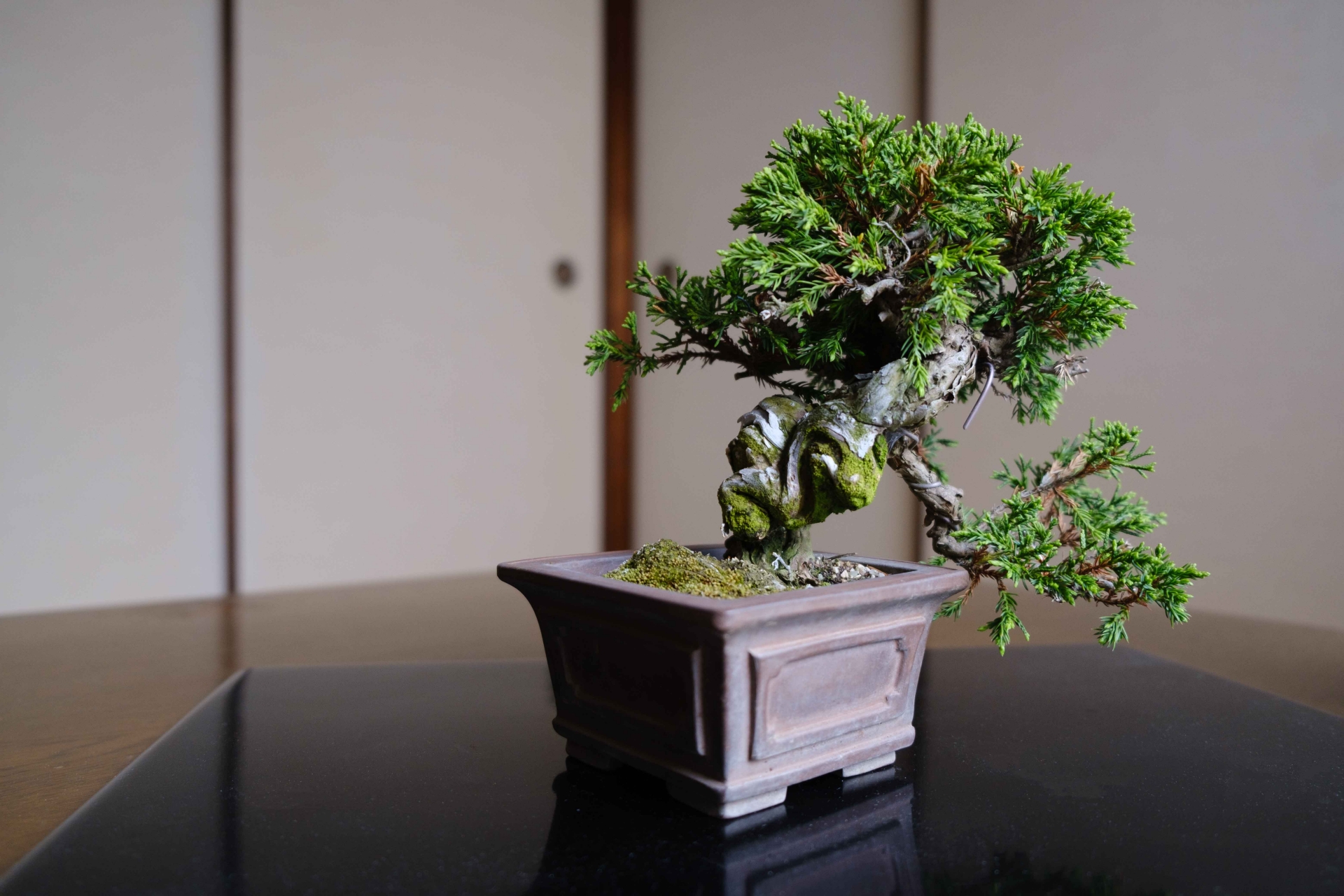
盆栽の鑑賞では、鉢の中に凝縮された大自然の情景を思い描くことが大切だとされています。
根、幹、枝、葉を辿りながら、その向こうにある山野の景色を想像するのです。
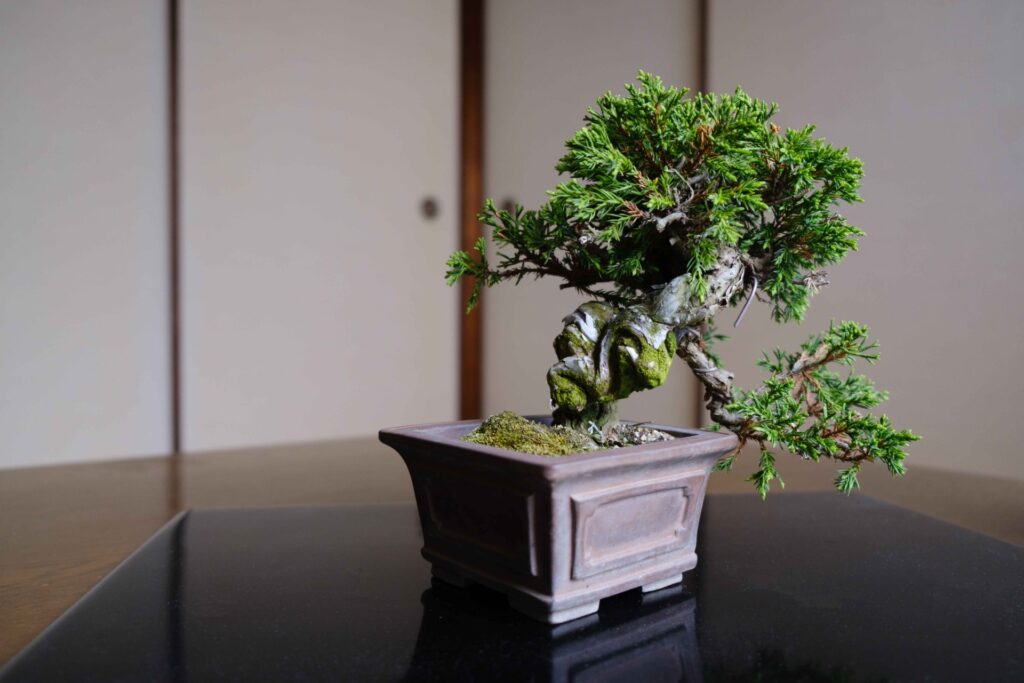
大きく張り出した根、荒々しく割れた幹肌、空へ向かって勢いよく伸びる枝。
濃い緑の葉が幾重にも重なり、悠々と広がる姿……。
時には慎ましく、時には絢爛で雄大。
完成された盆栽には目が釘付けになるような、一瞬たりとも目が離せなくなるほどの、圧倒的なバランスの美を見ることができます。
人は造形の美しさよりも、圧倒的なバランスの美に惹かれるものだと私は思っているのです。
けれど、盆栽の美しさは簡単には語ることのできないものです。
人の意志だけで作ることはできず、木の生命力だけでも生まれない。
その間に現れるものが、盆栽なのでしょう。
自然らしさは、人の手から生まれる
盆栽は自然の美を表す芸術ですが、自然のまま放っておいても盆栽にはなりません。
剪定、芽摘み、植え替え、針金掛け……。
木の状態を見ながら、様々な手入れが重ねられます。
黒松では、葉を小さく引き締まった姿に育てるため、「短葉法」と呼ばれる技術が用いられます。
新芽を切る芽切り、不要な芽を取り除く芽かき、古い葉を間引く葉すかしなどを、季節や木の勢いに合わせて行います。
短葉法は、単に葉を短く切るのではなく、植物の成長の仕組みを利用して、次に出る葉そのものを短く育てる技術です。
針金掛けも、ただ枝を人の望む形に曲げる作業ではありません。
雨や風、雪に耐える自然の樹木の姿を、鉢の上に表現する技術の一つですが、一方で、針金掛けを嫌う樹種もあるため、すべての木に同じ方法を施すことはできません。
人が一方的に形を押しつけるのではなく、どこまで手を入れられるか、いつ枝を切るか、今は形を整えるべきか、
それとも木の力を蓄えさせるべきか……。
育て手は、木の性質とその年の状態を読みながら、手を加えることと待つことを選び続けるのです。
これは私の想像ですが、盆栽家にとって、待つ時間というのは一種の試練なのでしょう。
切りたい思いを我慢して木の成長を待つということは、人の成長を促すものでもあるのだとろうと想像します。
なぜなら、植物の成長には時間を要するからです。
ちょっと野暮な話をすれば、来月の展覧会までに間に合わせたいとか、そんなことは木には関係のない話。
本気で盆栽と向き合えば、もしかすると人間としてのすべての資質を手に入れられるのかもしれないなと、ふと思いました。
一つの木から、山を想像する
優れた盆栽では、根元が土をしっかりとつかみ、幹は根元から上へ向かって自然に細くなり、枝は全体の輪郭を形づくります。歳月によって隆起した根は生命力を表し、古い松の幹肌には、幾重にも積み重なった時間が現れます。
そのどっしりとした根からは大地の広がりが、幹の太さからは巨大な古木が連想されますが、枝の間に作られた空間は、霧や風が通り抜ける余白となって、一幅の日本画のような風流が密度をもって表されます。
よい盆栽は、根や幹や枝の中に、大自然を思わせるような手がかりが配置されていますが、すべてを見せるのではなく、一部を示すことで、見えないものを立ち上がらせるという、日本文化特有の美意識を見ることができるでしょう。
鑑賞者もまたその一鉢に心を宿し、その風景を体感することで、その盆栽の使命は完成されるのかもしれません。
完成は、ひとときの姿
盆栽には、間違いなく完成された美だと思える時期があります。
枝の姿が定まり、葉の大きさが揃い、鉢との調和も美しく、非の打ち所のないバランスの取れたその姿は、
盆栽を知らない人でも心を鷲掴みにされるほどの芸術性の高さと、品格を備えています。
けれど、ほんの数時間で芽吹き、枝が伸び、葉が茂り、根は鉢の中に広がっていきます。
冬には落葉し、古い枝の一部が枯れることもあります。
これは盆栽に限った話ではありませんが、完成すれば崩れるという万物流転の法則はどんなものにも当てはまり、
どれほど美しさを誇った作品でも、それを永遠に留めおくことはできません。
しかし、それは木が生きているということ。
育て手は崩れはじめた姿を見ながら、次にどの枝を伸ばし、どの芽を残し、どんな風景へ導いていくかを考える。
そして、また次の完成へと向かわせる。
むしろそこが面白いところなのかもしれません。
言い方を変えれば、循環ということなのでしょう。
一鉢の中にすべてが凝縮されると言われる優れた盆栽は、陰陽の循環が正しく行われているのではないか、
そんな気がしました。
永遠に留められないからこそ、その時の姿を見つめる。
盆栽にも、その感性が息づいているように思います。
何百年もの手が、一鉢に重なる
古い盆栽の価値は、単に樹齢の数字だけでは決まりません。
力強い根張りや幹、枝先まで行き届いた技術、健康な樹勢、鉢との調和、そして誰が育て、誰から誰へと受け継がれてきたのかという来歴も、その木の価値を形づくります。
大宮盆栽美術館が所蔵する欅の名樹には、元首相吉田茂が愛蔵し、その後別の所有者へ託されてきた歴史があります。美術館はその魅力を、力強い根張りや太い幹、精巧な枝先だけでなく、由緒ある所蔵歴を含めて紹介しています。
高価な盆栽に付けられた値段には、「何百年生きた木だから」という一言では説明できない高い付加価値があります。何代もの人が水を与え、植え替え、枝を整え、木を枯らすことなく次の人へと託してきたその価値は、当然のことながら一朝一夕に得られるものではないのです。
それは言い換えれば、無数の判断の歴史です。切った瞬間二度と元には戻らない枝、少しの時期の違いが、木の生育を左右することもあります。
人は未来の姿を想像して手を入れますが、その未来を完全に支配することはできません。だからこそ、長く受け継がれてきた盆栽には技術と偶然、成功と失敗、木の生命と人の願いが混在し、その重厚さに人は自ずと価値を見出すのでしょう。
両者の絆
一鉢の盆栽には過去の完成も、現在の揺らぎも、まだ見えぬ未来の姿も、共に宿っています。
変わり続ける生命の美しさを信じること。そこに、盆栽に宿る日本の美と祈りがあるように思います。
一鉢に美を凝縮する。
木にとって、それが幸福なのかどうかはわかりません。
もしかするとそれは、盆栽家のジレンマのようなものかもしれません。
ですが、長年連れ添った盆栽と育て手の間には、もしかすると信頼関係や絆のような感覚が芽生えているのかもしれないなと感じました。
まるで手に負えない馬を調教するかのように、荒馬のような木も、育て手の愛によって知らず知らずのうちに、その心と形を整えていく。
そういうことは、どの世界にもあることなのでしょう。
技術を磨き、美意識を養い、木と向き合いながら心を整えていく。
それは昔の人が残してくれた、人生をかけて楽しむ静かな遊びなのかもしれません。
盆栽の奥深さを感じることができました。
美しさに宿る祈り――つゆらのまなざし
―― 文:安東瑠璃
つゆらストアのご案内
つゆらの世界観を小さな形にしました。つゆらストアにてご覧いただけます。
オリジナル画像制作も承りますので、もしよろしければどうぞ🍀
The Beauty and Prayer of Japan
Episode 8 | Bonsai
The Overwhelming Beauty of Balance
In appreciating bonsai, it is said to be essential to envision the grandeur of nature condensed within the pot.
As the eye follows the roots, trunk, branches, and leaves, one imagines the mountains and fields that lie beyond.
Roots spreading boldly outward, bark roughened and cracked with age, branches reaching vigorously toward the sky.
Deep green leaves layered one upon another, unfolding in unhurried grandeur……
At times restrained, at times resplendent and magnificent.
In a fully realized bonsai, one finds an overwhelming beauty of balance—the kind that fixes the eye and will not let it wander, even for a moment.
I have come to believe that people are drawn not to beauty of form alone, but to this overwhelming beauty of balance.
And yet, the beauty of bonsai is not something easily put into words.
It cannot be created by human will alone, nor can it arise from the tree’s life force alone.
Bonsai, perhaps, is what emerges in the space between the two.
Naturalness, Born of the Human Hand
Bonsai is an art that expresses the beauty of nature, yet a tree left entirely to nature will never become bonsai.
Pruning, pinching new buds, repotting, wiring……
Countless forms of care are layered on, each shaped by close observation of the tree’s condition.
For black pines, a technique called tanyo-hō (the “short-needle method”) is used to cultivate needles that grow small and tightly gathered.
Depending on the season and the vigor of the tree, growers practice mekiri (cutting new candles), mekaki (removing unwanted buds), and hasukashi (thinning old needles).
Tanyo-hō does not simply cut the needles short—it draws on the plant’s own mechanism of growth so that the very next needles to emerge grow shorter by nature.
Wiring, too, is not merely a matter of bending branches into a shape of one’s choosing.
It is one of the techniques used to express, atop a pot, the form of a tree that has withstood rain, wind, and snow in the wild—though some species resist wiring, so the same method cannot be applied to every tree.
Rather than imposing a shape unilaterally, the grower must judge how far to intervene, when to cut a branch, whether now is the time to refine the form,
or whether the tree should instead be left to gather its strength……
Reading the nature of the tree and its condition in a given year, the grower continues to choose, again and again, between intervening and waiting.
This is only my own imagining, but for a bonsai grower, the time spent waiting may itself be a kind of trial.
To hold back the urge to cut, and instead wait for the tree to grow, is, I imagine, something that fosters the grower’s own growth as well.
For growth, in a plant, always takes time.
To put it a little indelicately: wanting to have it ready in time for next month’s exhibition is simply of no concern to the tree.
It occurred to me that facing bonsai in earnest might, in the end, cultivate every quality a person could hope to possess.
From a Single Tree, a Mountain Imagined
In a fine bonsai, the base of the roots grips the soil firmly, the trunk tapers naturally as it rises, and the branches shape the tree’s overall silhouette. Roots raised by the passage of years express vitality, and in the bark of an old pine, time itself appears, layered again and again.
From those solid, weighty roots, one senses the breadth of the earth itself; from the thickness of the trunk, the image of some vast and ancient tree. Yet the spaces left between the branches become a kind of margin, through which mist and wind seem to pass—and there, with quiet density, the elegance of a Japanese ink painting comes into view.
In good bonsai, the roots, trunk, and branches are arranged with clues that call nature itself to mind—yet without showing everything. In revealing only a part, and thereby summoning what remains unseen, one can glimpse an aesthetic sensibility distinctive to Japanese culture.
Perhaps it is only when the viewer, too, lets their heart dwell within that single pot and experiences its landscape for themselves, that the bonsai’s purpose is truly fulfilled.
Completion, a Fleeting Form
There are, without question, moments when a bonsai seems to embody a completed beauty.
The branches settled into form, the leaves uniform in size, harmony achieved with the pot, its balance flawless and beyond fault—
such a form carries an artistry and dignity so striking that it seizes the heart even of those who know nothing of bonsai.
And yet, hour by hour, buds break, branches lengthen, leaves thicken, and roots spread further within the pot.
In winter, leaves fall, and at times, part of an old branch will wither and die.
This is not true of bonsai alone: the law that all things, once complete, begin to crumble applies without exception to everything,
and however magnificent a work’s beauty may be, it can never be held in place forever.
But that, simply, is what it means for a tree to be alive.
Watching the form as it begins to give way, the grower considers which branch to let grow next, which bud to leave, and what landscape to guide the tree toward.
And so the tree is drawn, once again, toward its next completion.
Perhaps that, in fact, is where the true interest lies.
To put it another way, this is perhaps simply cycle, and renewal.
In a fine bonsai—said to hold everything condensed within a single pot—I sensed that the cycle of yin and yang was, perhaps, unfolding just as it should,
or so it felt to me.
Precisely because nothing can be held forever, one looks closely at the form it takes in this moment.
That same sensibility, I think, breathes within bonsai as well.
Hands Across the Centuries, Layered in a Single Pot
The value of an old bonsai is not determined by the number of its years alone.
A vigorous spread of roots and trunk, technique carried through to the very tips of the branches, healthy vitality, harmony with the pot, and provenance—who raised it, and through whose hands it passed—all shape a tree’s worth.
A celebrated zelkova held in the collection of the Omiya Bonsai Art Museum carries a history of its own: once cherished by former Prime Minister Shigeru Yoshida, it was later entrusted to other owners in turn. The museum presents its appeal not only through its powerful roots, thick trunk, and finely wrought branch tips, but through this storied provenance as well.
The price attached to a costly bonsai carries an added value that cannot be explained by the simple fact that “this tree has lived for centuries.” Generation after generation, people have watered it, repotted it, shaped its branches, and passed it on to the next without letting it die—and that value, naturally, is not something acquired overnight.
In other words, it is a history of countless decisions. A branch, once cut, can never be returned to what it was; even a slight difference in timing can determine how the tree will grow.
People intervene while imagining a future form, yet they can never fully command that future. Perhaps that is precisely why a bonsai handed down over many years holds within it a mingling of skill and chance, success and failure, the tree’s own life and the wishes of those who tended it—and why people find, in that weight and depth, a value all its own.
The Bond Between the Two
Within a single pot of bonsai dwell the completion of the past, the unsettled present, and a future form not yet seen.
To believe in the beauty of a life that never stops changing—there, I think, lies the beauty and prayer of Japan that dwells within bonsai.
To condense beauty into a single pot.
Whether that is happiness for the tree, I cannot say.
Perhaps it is something like a dilemma every bonsai grower must live with.
And yet, I have come to feel that between a bonsai and the grower who has stayed beside it for years, something like trust—something like a bond—may quietly take root.
As though taming an unruly horse, even a wild, headstrong tree comes, through the grower’s love, to settle both its spirit and its form—almost without anyone noticing.
Such things, I suspect, happen in every world, in every craft.
Honing one’s technique, cultivating an eye for beauty, and settling one’s own heart while facing the tree.
Perhaps this is a quiet pastime, left to us by those who came before—one meant to be savored over the whole course of a life.
I found myself, once again, feeling the depth of bonsai.
The Prayer That Dwells in Beauty — Tsuyura’s Perspective
— Written by Ruri Ando
Tsuyura Store
A small expression of the Tsuyura world, shaped into tangible form.