
緑濃く燃ゆる大地。
龍の気配息づくこの国に生きる私たちの心を、豊かに彩ってくれる日本文化の数々。
私たちはもっともっと我らが文化を誇り、愉しむべきでしょう。
あなたはどんな日本文化がお好きですか?
今回のテーマは「琴」です。
さぁ、ひとまず日常の煩わしさは忘れて、共に日本の美と祈りの世界に没入しましょう🌸
第七話 琴
弦がひらく、雅のからくり
琴の音。
その一音が立ち上がる時、そこには鮮やかな出来事がある— —
和楽器の中でも特に典雅な印象をもつ楽器、琴。
澄んでいるのに芯があり、雅でありながら、はっきりとした輪郭があります。
清水の流れるがごとき流麗な調べは琴の真骨頂ですが、時に鋭く、時に力強く、空気をきらりと切りひらくような強さを見せることもあります。
また雅な印象と共に、琴の音色の美しさは、楽器の中でもひときわ複雑なものではないかと感じます。最初に耳に届く明るい輪郭、その奥にある木の響き、さらには弦の震えが作る細かな揺らぎ。
ひとつの音でありながら、そこには幾つもの層が重なり、その音の正体を簡単には掴みきれない。
光を含んだ絹糸のように微細な揺れを持ち、正確でありながら、どこか生き物のように変化する。艶があり、深く、そして謎めいている。
幽玄の美をつよく感じるがゆえに、そのある種難解な音の美を前にして、私は時々、その圧倒的な世界観を捉え切れないもどかしさを感じることがあります。
それは、私だけの感覚でしょうか。
柱と左手がつくる、音のからくり
現代では一般的に「琴(こと)」と総称されることが多いですが、厳密には、可動式の柱(じ)を立てて音程を調えるものを「箏(そう)」と呼びます。一方、柱を使わず、弦を押さえる位置によって音を作るものが本来の「琴(こと)」です。
暮らしの中では「お琴」という呼び名で深く親しまれてきました。ここでは、主に日本の箏を中心に見ていきますが、表記は「琴」で統一します。
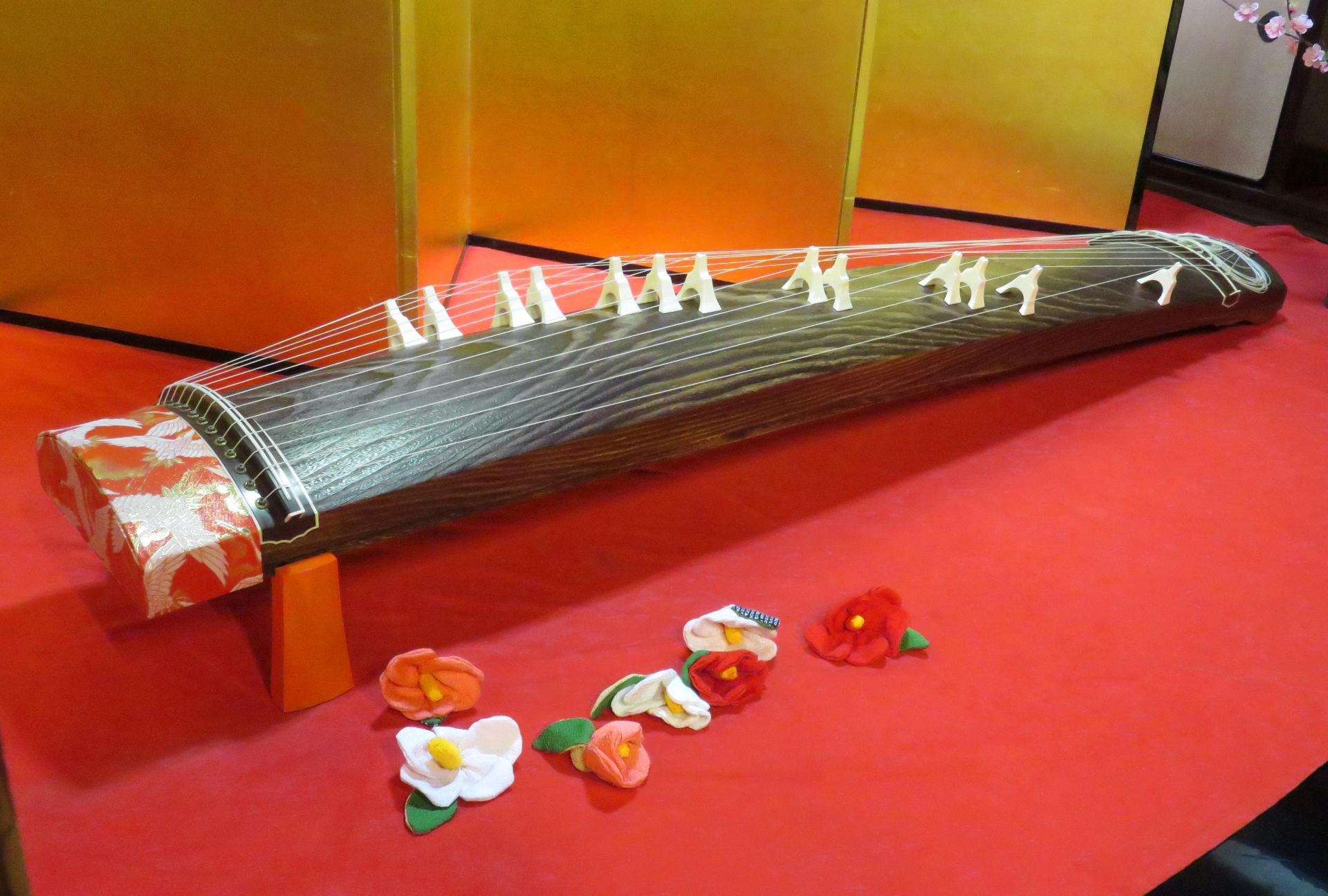
簡単に言ってしまえば、琴は長い木の胴に弦が張られているだけの、きわめてシンプルな作りをしています。けれどその一見簡素な姿の中に、音を生み、変化させ、歌わせるための精妙な仕組みが隠されています。
琴の胴には主に桐が用いられます。
桐は軽くて湿気による狂いが少なく、響きにも優れていることから、古くより琴の材料として重宝されてきました。
また琴は、音を奏でる楽器であると同時に、その姿を愛でる工芸品でもあります。
上質な琴には蒔絵や螺鈿が施されることがあり、流水や草花、四季の風景などが繊細に描かれてきました。
琴を収める袋にも美しい裂地が用いられ、その佇まいには日本人が育んできた雅な美意識が息づいています。
さらに興味深いことに、琴は古くから龍の姿に見立てられてきました。演奏者から見て右端の部分は「龍頭」、反対側は「龍尾」と呼ばれ、他の部分にも龍にちなんだ名称が付けられています。一挺の琴をまるで生き物のように捉え、敬意をもって扱ってきたのでしょう。
実用品の中に美を宿し、その美に意味を見出す。琴の姿には、日本文化が大切にしてきた美と精神性が静かに表れているように思えます。
それではここで、琴の音のからくりについて見ていきましょう。
弦楽器にも様々なものがあります。
たとえばピアノもまた、弦の振動によって音を生む弦楽器の一つですが、ピアノと琴がまったく別の種類の音を響かせるのは、弦に対するアプローチの仕方が大きく違うからに他なりません。
ピアノの場合、演奏者の指が弦に直接触れるわけではなく、鍵盤を叩くことによって内部のハンマーが弦を打ち、そこで初めて発音されます。
そのため、ピアノの音には構造化された明晰さがあります。音は均質に整えられ、広い音域を正確に響かせることができます。
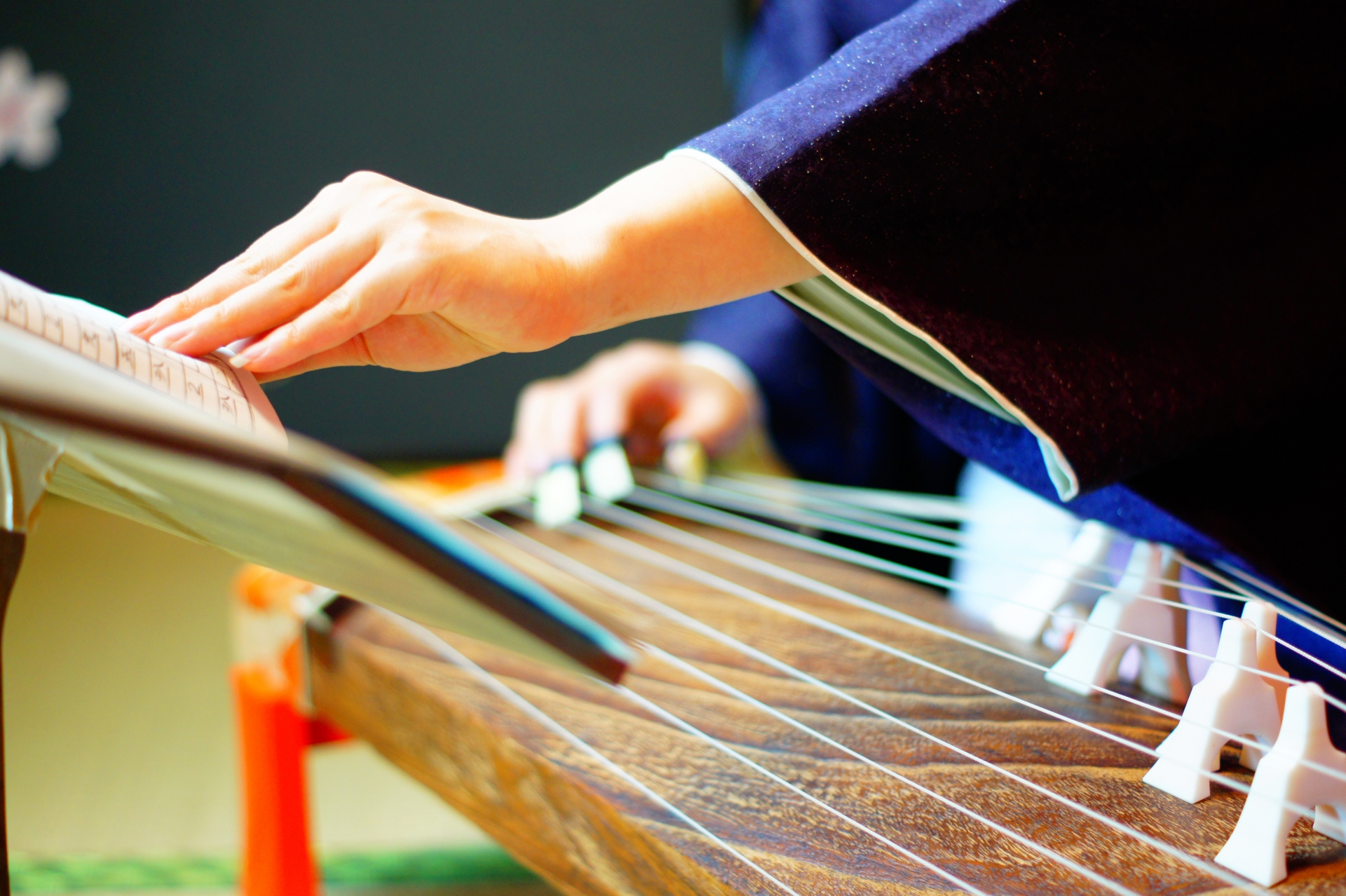
一方で、琴は爪をつけた指で直接弦を弾きます。弦と演奏者の距離はとても近く、爪の角度や弾く強さ、離れる速度、手首の動き、そうしたわずかな違いが、音の立ち上がりや表情にそのまま現れます。
琴の柱(じ)は弦の支柱ですが、弦の下に立てられたこの柱の位置を動かすことで、それぞれの弦の音程が決まります。つまり琴は、演奏前に曲にふさわしい音階を作ってから奏でる楽器です。
あらかじめ選ばれた音たちによって作り出される世界。その制約があるからこそ、音の並びにはひとつの気配が生まれます。どの音を用意し、どの音を鳴らし、どの音を鳴らさないのか。そこに、調べの美学があります。
けれど、琴の音色の幅や奥行きはそれだけでは決まりません。ここで重要なのが、左手の動きです。
右手が弦を弾く一方で、左手は柱の左側の弦に触れ、押したり引いたりしながら音に変化を与えます。この所作により、音程をわずかに上げたり、揺らしたり、表情を添えたりすることができます。
右手が弦を弾いた瞬間、素の音が生まれ、次に左手が弦に圧をかけることで音は持ち上がり、揺れ、色を変えて、趣きをまとった音の連なりが流れだすのです。
つまり琴は音を鳴らしたあとに、その音を育てていく楽器であり、その音を整えることこそが演奏者の力量なのかもしれません。
素の音は直線的なものですが、それがたわみを持った曲線になって初めて、抑揚のある優雅な琴の音になります。
ピアノが音の瞬発性を愉しむ楽器だとすれば、琴は音の熟成を愉しむ楽器と言えるでしょう。
暮らしへひらかれてきた音
琴は、古くは宮廷や儀式の場と深く結びついてきた楽器です。
奈良時代に大陸から伝わった箏は、雅楽の楽器のひとつとして用いられ、琵琶や笛などとともに宮廷の音楽を支えてきました。
それは、単なる娯楽としての音楽ではなく、場を整えて儀礼を荘厳にし、人の心を日常とは異なるところへ運ぶための音色だったのでしょう。
時代を経るにつれ、琴の音は貴族の世界から武家へ、さらに町人の文化へと広がっていきます。やがて箏曲として発展し、人々の暮らしの中で親しまれるようになりました。
ここで一曲ご紹介しましょう。お正月のお琴の定番『春の海』。
昭和四年、宮城道雄によって作曲されたこの曲は、穏やかな春の海と海鳥の気配を描いた作品です。
遥か彼方まで続く海の穏やかな広がりには、新年を佳き年にしたいという願いが込められたのでしょう。
静かな波間が真新しい陽光を受けて、まるで鏡面のようにきらきらと輝いている。
『春の海』はそんな幸せな情景を想起させてくれる、日本が誇る名曲です。
江戸時代以降、箏曲には大きく分けて生田流と山田流という二つの流派があります。
生田流は器楽的な表現に重きを置くことが多く、華やかな手事や三曲合奏の中で、箏の細やかな技が生かされてきました。
爪は角爪を用い、楽器に対して斜めに座る姿勢も特徴のひとつです。
一方、山田流は、歌の表現や物語性を大切にしてきた流派です。
丸みを帯びた爪を用い、箏に対して正面に座って演奏します。
そこでは、箏の音が歌と結びつき、言葉の情感を支えるように響いていきます。
同じ琴でありながら、流派によって音の向かう先が少しずつ違う。これはとても興味深いことです。
琴はただ決められた音を鳴らす道具ではなく、人がどのように美を見つめ、何を大切にしてきたかによって、その表情を変えてきた楽器でもあるのです。
そしてもうひとつ、琴には意外な親しみやすさがあります。
それは、お稽古ごととして考えた時、最初の一音を容易く出すことができるという点です。弦を弾けばすぐに音は立ち上がるのですから、第一音までたどり着くのに時間がかかる龍笛や篳篥(ひちりき)のような難しさはありません。
琴は最初の入口がやさしい楽器と言えるでしょう。
音を整えるという祈り
弦の緊張感、所作の端正さ、音の変化の精妙さ。
そこには、深く整えられた日本的な華やぎがあります。
平安の装束、蒔絵、能装束、金屏風、祭礼の飾り。
どれも目を奪うほどの華やぎがありますが、その華やぎは単なる派手さとは違い、決まりごとや秩序、抑制や間合いの中で、色や形が最上級に生かされています。
琴の音にも、これと似た稀有な輝きが存在します。
強い音、速い動き、華やかな連なり。その中にも、必ずどこかに秩序や抑制という名の整えがあります。
豪華でありながら、野放図ではない。極めて雅でありながら、濁らない。
その均衡は、日本人が古より培ってきた感性と理性が生み出すものなのではないでしょうか。
日本では、台所や井戸、火や水、家の隅々にまで神様の気配を見出してきました。世界の宗教のように毎日、毎週礼拝所に通うわけではなくても、私たちが親しむ日本文化には祈りの要素が多分に含まれています。
そして琴は、神様に音色を捧げる楽器でもあります。
最上の音色を奏でるために弦を整えること。爪を添え、一音を立ち上げること。そしてその音に息吹を与えること……。
それらが琴における一つの祈りの形とするならば、弦が震えるその時、そこには鮮やかな祈りの言葉が満ちているのかもしれません。
私はふと、琴を習ってみたくなりました。
美しさに宿る祈り――つゆらのまなざし
―― 文:安東瑠璃
つゆらストアのご案内
つゆらの世界観を小さな形にしました。つゆらストアにてご覧いただけます。
オリジナル画像制作も承りますので、もしよろしければどうぞ🍀
The Beauty and Prayer of Japan
Episode 7 | Japanese koto
When strings unfold elegance
The sound of the Japanese koto.
When that single note rises into the air, something vivid takes place—
Among Japanese traditional instruments, the koto carries an especially elegant impression.
Its sound is clear yet has substance, graceful yet sharply defined.
A flowing melody like pure water is the very essence of the koto, yet at times it can be sharp, at times powerful, revealing a strength that seems to cut brilliantly through the air.
Along with its elegant impression, I feel that the beauty of the koto’s tone may be among the most complex of all instruments. There is the bright outline that first reaches the ear, the resonance of wood behind it, and further still, the subtle fluctuations created by the trembling of the strings.
Although it is a single note, many layers overlap within it, making the true nature of the sound difficult to grasp with ease.
It carries delicate tremors like silk threads holding light. It is precise, yet somehow changes like a living being. Lustrous, deep, and mysterious.
Perhaps because I feel such a strong sense of yūgen in it, I sometimes find myself frustrated before the somewhat elusive beauty of its sound, unable to fully grasp the overwhelming world it contains.
Is that only my own impression?
The mechanism of sound created by bridges and the left hand
Today, the instrument is commonly referred to simply as “koto.” Strictly speaking, however, the instrument whose pitch is adjusted using movable bridges (ji) is called a so. By contrast, the original koto produces notes by changing the position at which the strings are pressed, without the use of bridges.
In everyday life, however, it has long been affectionately known as okoto. In this essay, we will focus primarily on the Japanese so, but for simplicity, I will use the familiar term “koto” throughout.
Put simply, the koto has an extraordinarily simple structure: strings stretched across a long wooden body. Yet hidden within that seemingly modest form is an intricate mechanism designed to create, shape, and animate sound.
The body of the koto is most often made from paulownia wood.
Lightweight, resistant to humidity-related warping, and highly resonant, paulownia has long been treasured as the ideal material for crafting koto.
The koto is not only a musical instrument but also a work of craftsmanship meant to be admired.
Fine instruments are often adorned with maki-e lacquer decoration or raden mother-of-pearl inlay, delicately depicting flowing water, flowers, and scenes of the changing seasons.
Even the bags used to store the koto are made from beautiful textiles, reflecting the refined aesthetic sensibility cultivated by the Japanese people over generations.
More intriguingly still, the koto has long been likened to a dragon. The right end of the instrument, from the player’s perspective, is called the “dragon’s head,” while the opposite end is known as the “dragon’s tail.” Other parts of the instrument also bear names associated with dragons. It seems that people regarded a single koto almost as a living being and treated it with reverence.
To discover beauty within practical objects and meaning within that beauty—this spirit quietly reveals itself in the form of the koto. In its appearance, one can glimpse the aesthetic and spiritual values that Japanese culture has long cherished.
Let us now take a closer look at the mechanism behind the koto’s sound.
There are many kinds of stringed instruments.
The piano, for example, is also a stringed instrument that produces sound through the vibration of strings. Yet the reason the piano and the koto create entirely different worlds of sound lies in their fundamentally different approaches to those strings.
With the piano, the performer’s fingers never touch the strings directly. Pressing a key causes an internal hammer to strike the string, and only then is sound produced.
As a result, the piano possesses a structured clarity. Its tones are carefully standardized, allowing a wide range of notes to resonate with precision.
The koto, by contrast, is played by plucking the strings directly with finger picks. The distance between performer and string is remarkably close. The angle of the pick, the strength of the pluck, the speed of release, even subtle movements of the wrist—all of these are reflected directly in the emergence and character of the sound.
The bridges (ji) of the koto serve as supports for the strings. By moving the position of these bridges beneath the strings, the pitch of each string is determined. In other words, the koto is an instrument whose scale is arranged before performance to suit a particular piece.
A world created from notes chosen in advance. It is precisely because of this limitation that a certain atmosphere emerges from the arrangement of sounds. Which notes are prepared, which are played, and which are left silent—within these choices lies the aesthetics of melody.
Yet the breadth and depth of the koto’s tone are not determined by this alone. Another essential element is the movement of the left hand.
While the right hand plucks the strings, the left hand touches the portion of the string to the left of the bridge, pressing or pulling it to alter the sound. Through this gesture, the performer can slightly raise the pitch, create vibrato, and add subtle expression.
The moment the right hand plucks a string, a pure tone is born. Then the left hand applies pressure, lifting the pitch, causing it to waver, changing its color, and setting into motion a stream of notes imbued with nuance and character.
In this sense, the koto is an instrument that nurtures a sound after it has been born, and perhaps a performer’s true skill lies in shaping and refining that sound.
A raw tone is linear, but only when it bends into a curve does it become the graceful and expressive sound of the koto.
If the piano is an instrument that celebrates the immediacy of sound, then the koto may be an instrument that celebrates its maturation.
A sound that opened itself to everyday life
The koto is an instrument that has long been closely associated with courts and ceremonial occasions.
Introduced from the Asian continent during the Nara period, the sō became one of the instruments of gagaku, the ancient court music of Japan. Alongside the biwa and various flutes, it helped shape the musical world of the imperial court.
Its sound was not merely a form of entertainment. Rather, it was a voice that ordered a space, lent dignity to rituals, and carried the human spirit beyond the boundaries of everyday life.
As the centuries passed, the sound of the koto spread from the world of the aristocracy to that of the warrior class, and eventually into the culture of ordinary townspeople. Over time, it developed into the tradition of sōkyoku and became deeply woven into everyday life.
Allow me to introduce one famous piece: Haru no Umi (The Sea in Spring), a beloved staple of New Year celebrations in Japan.
Composed in 1929 by Michio Miyagi, the work portrays the gentle sea of spring and the presence of seabirds drifting through the air.
Perhaps within its vast and tranquil seascape lies a wish that the coming year may be a fortunate one.
Quiet waves catch the light of a fresh new sun, sparkling like a mirror across the water.
Haru no Umi is one of Japan’s treasured masterpieces, capable of calling forth just such a peaceful and joyful scene.
Since the Edo period, the tradition of koto music has been broadly divided into two major schools: the Ikuta School and the Yamada School.
The Ikuta School places particular emphasis on instrumental expression. Within its brilliant solo passages and ensemble performances, the subtle techniques of the koto have been cultivated and refined.
Its performers use angular finger picks and characteristically sit at an angle to the instrument.
The Yamada School, by contrast, has long valued vocal expression and storytelling.
Its performers use rounded finger picks and sit facing the instrument directly.
There, the sound of the koto becomes closely intertwined with song, resonating in a way that supports the emotional nuance of words.
Though it is the same instrument, the destination toward which its sound travels differs subtly from one school to another. This is a deeply fascinating aspect of the koto tradition.
The koto is not merely a tool for producing predetermined notes. It is also an instrument whose character has changed according to how people have perceived beauty and what they have chosen to cherish.
There is also another, perhaps surprising, aspect to the koto: its accessibility.
For those considering it as a form of study, the very first note can be produced with relative ease. Once a string is plucked, sound immediately emerges. Unlike instruments such as the ryūteki flute or the hichiriki, where even producing the first note can require considerable effort, the koto offers a more welcoming beginning.
In that sense, the koto may be said to be an instrument with a gentle entrance.
Tuning sound as prayer
The tension of the strings, the elegance of each gesture, the subtle refinement of changing tones.
Within them resides a distinctly Japanese form of splendor—one that has been carefully cultivated and refined.
Heian court robes, maki-e lacquerware, Noh costumes, golden folding screens, and festival decorations.
All possess a dazzling beauty, yet that beauty is not mere extravagance. Rather, color and form are elevated to their highest expression through rules, order, restraint, and a keen sense of balance.
A similar and rare brilliance exists in the sound of the koto.
Powerful tones, swift movements, and brilliant passages. Yet within them, one always finds an underlying order, shaped by restraint and careful refinement.
Luxurious, yet never excessive. Profoundly elegant, yet never clouded.
Perhaps this balance is born from the harmony of sensibility and reason that the Japanese people have cultivated throughout the centuries.
In Japan, people have long sensed the presence of the divine in kitchens and wells, in fire and water, and in every corner of the home. Even if we do not attend places of worship daily or weekly in the manner of many world religions, the culture we cherish contains a great many elements of prayer.
And the koto, too, is an instrument through which sound is offered to the divine.
To tune the strings in pursuit of the finest possible tone. To place the picks upon one’s fingers and bring forth a single note. And then to breathe life into that sound…
If these acts may be regarded as one form of prayer within the world of the koto, then perhaps, at the very moment the strings begin to tremble, the air becomes filled with vivid words of prayer.
Quite suddenly, I found myself wanting to learn the koto.
The Prayer That Dwells in Beauty — Tsuyura’s Perspective
— Written by Ruri Ando
Tsuyura Store
A small expression of the Tsuyura world, shaped into tangible form.